craftED
is the blog for The Germantown Academy Professional Development Program.

Sunday, May 8, 2016

Flipping My Classroom: Guest Blogger Rebecca Burnett


Sometimes, my kids get sick.  Sometimes, it snows.  Sometimes, half my class is missing for an away game last period.  In each of these situations, I have found it’s hugely helpful to have some digital content in my back pocket so that students can still have a useful class experience, even when we’re not in the same room together.  Because the curriculum keeps advancing and students can work through this part of it independently, I am able to spend the quality time we do have together discussing at the Harkness table.  The VLE affords me a great opportunity to do something productive with the students while we are apart, enabling our time together to be as effective as possible.  

My favorite way to flip the classroom is to use SMART recorder to record an opening lecture for a unit or some other form of video lesson.  This year, when it snowed just as we were about to start A Midsummer Night’s Dream in English 9, I was able to buy back valuable instruction time by recording my introduction to Shakespeare using SMART recorder, uploading it to youtube, and embedding that lecture on the VLE.  For homework, the students watched the lecture, which meant we could read Shakespeare together in class.  Rather than asking students to muddle through the first scene of the play on their own, I was able to provide hands on assistance as they worked through the text in the classroom.  Delivering the lecture through the VLE bought me that time.  It also allowed students to go back and check parts of the lecture when they had questions.  While this method was a happy accident this year, I plan to always deliver the lecture virtually in the future.  

I also once used the online discussion tool on the VLE to allow AP students to lead class discussions in which I could participate when I was away at a conference.  I set aside our regular class time for students to read the novel, and then asked students to check into a digital discussion within a 6 hour window that evening.  Students needed to post a minimum of one comment, but they wound up really engaging each other in dialogue, checking back several times over the course of the evening to see what others had said and respond.  I was able to be online from my hotel in Boston and participate with the students in real time.  While I definitely prefer to have these conversations in person and during the school day, as I prefer face-to-face interaction and am mindful of my students’ time in the evenings, in this instance, the VLE enabled me to remain connected to my students from another state.   

Sunday, May 1, 2016

EXCamp at GA: Sharing Expertise in Teaching

Monday, May 2, 2016 ~ Big Day at GA!

Germantown Academy faculty will attend the first all-school faculty EXCamp.  During two 35-minute sessions in the afternoon, a total of  twenty-five   teachers will present 35-minute sessions on topics of interest to them and their colleagues.  Topics include
·      Assessment-Based Curriculum Development,
·      Metacognition: How Thinking about Thinking Influences How We Teach and Learn,
·      Ways to use the VLE for more than just posting assignments,
·      Get Collaborating: Big Think Walls, Project Based Learning, and Student Centered Inquiry in the BCI
…and many more.

This event is a wonderful opportunity for peer-to-peer professional development.  The expertise of the GA faculty is a rich resource for all teachers, and on Monday, May 2, instead of going out, we are staying right here at GA and learning from one another.


Additionally, on the evening of Monday, May 2, Germantown Academy proudly welcomes award-winning author Jacqueline Woodson to our campus for a presentation for children and adults.  Ms. Woodson is the author of Brown Girl Dreaming and many other young adult books.  Please click here for more information.

Thursday, April 28, 2016

Empowering Students to Create and Share Content: Guest Blogger Rebecca Burnett


As we embark on school-wide conversations about differentiated assessment and digital literacy and citizenship, the VLE can provide an organic, subject-specific way to put those initiatives into practice.  

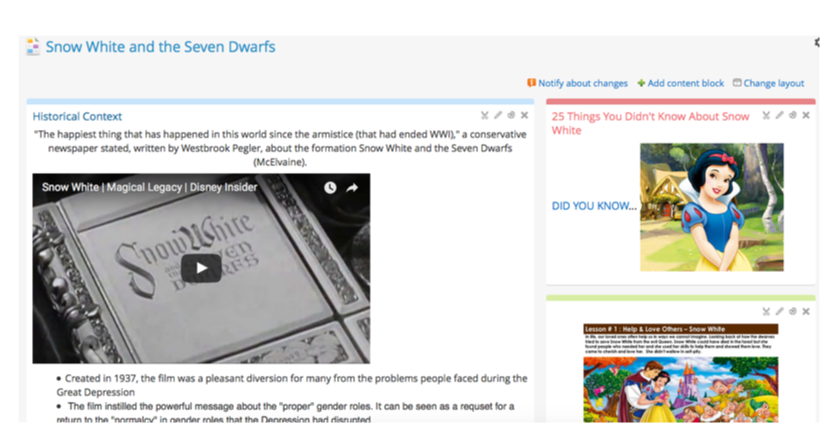
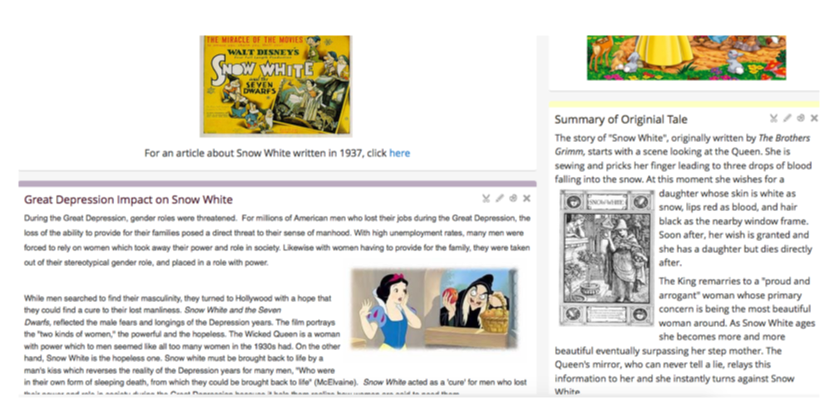
In several of my upper level and AP classes, I have asked students to do research on a relevant topic.  While I used to have to devote several class periods to monotonous Power Point presentations, I now ask students to develop VLE pages as a way to share the information they have found with their classmates.  As students develop these pages, I ask them to keep their audience in mind.  How much content would a reader want?  How might the reader be visually engaged by the page?  What is the optimum way to present/deliver content?  In effect, students become web designers, but the VLE enables them to build pages without having to know how to code.  As students develop their own multimodal texts, they think about the needs of a reader; thus, they develop both multimodal literacy and empathy at the same time.  Here is a sample of a student page providing background information on Disney’s Snow White and the Seven Dwarfs, a text students analyze in Fairy Tales:
 
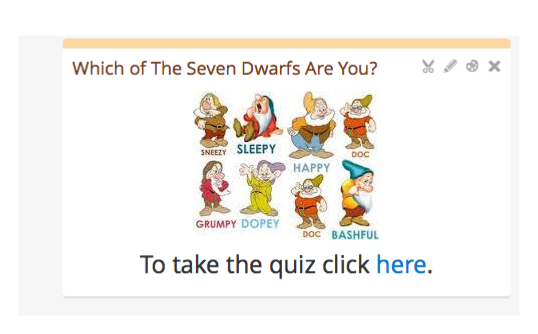
Because students are so comfortable in an online setting, they can also find ways to intersperse playful touches with the academic material.  For instance, this page included a Buzzfeed quiz:

Because students developed these resources themselves, they were more invested in the research.  Their classmates consumed the pages with pleasure, digesting more information than I could ever have hoped to deliver to them in a lecture on a similar topic.  Because the pages allow for elegant and streamlined delivery of large amounts of material in a short time, they can be browsed at home or in class and still leave me with more class time than I used to have when students did research presentations.  

I also used the VLE to create a digital assignment sheet for this project.  Putting the assignment sheet in a “note” enabled me to embed a youtube tutorial right in the assignment sheet:

I have also used the VLE to teach students how to write responsible, informed online comments.  In both Drag Identities and What Women Want, after students peruse a page of content on the VLE, I ask them to “comment” on what they read.  For these comments, I find that the online discussion tool on the VLE is the most useful platform, because it allows students to start new threads of discussion, to post original responses, and to reply to their classmates’ comments, directly.

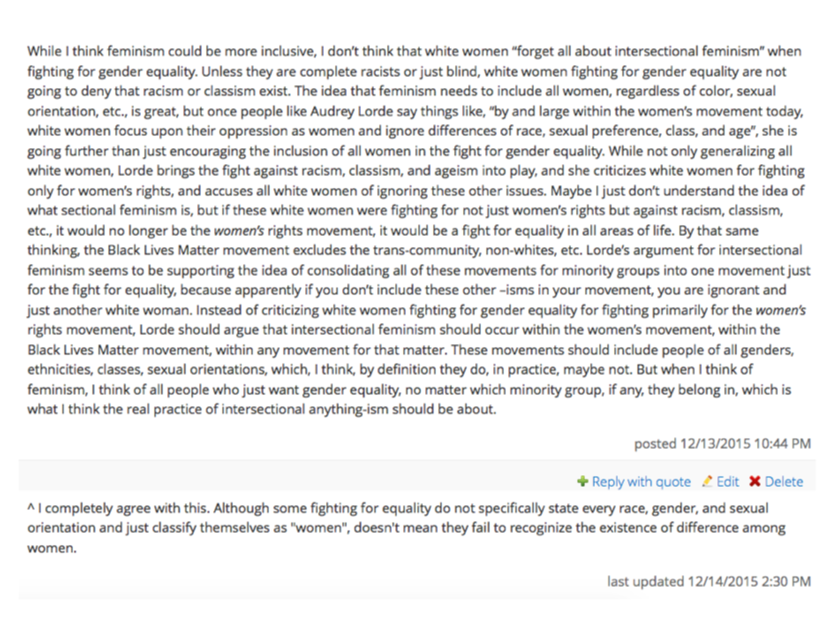
Here are a few sample comments from different threads on the “Intersectional Feminism” page:

In class, we talk explicitly about what makes a good comment and how to disagree with someone in a respectful, intelligent way, rather than devolving into the vitriol so often seen on public websites and social media.  These online posts are a particularly excellent opportunity for quieter students to make their voices heard; the longer comment above was from a student who barely spoke aloud all semester!

As you can see, the VLE has revolutionized my teaching.  At the same time, it has given me the gift of having additional time to sit with my students and talk about books.

Sunday, April 24, 2016

GA Salon: Celebrating Community, Conversation and Ideas


In the rush of school days, filled with classes, clubs, coaching, directing, planning, department and faculty meetings, teachers can be left hungry for collegial conversation about important topics ~ not necessarily related to school life.  To satisfy this desire, three years ago, GA instituted its first Germantown Academy Salon.


In the rich tradition of the 17th and 18th century salons, the GA Salon is an informal gathering of interested and interesting people who share a passion for ideas across a broad range of subjects.  In the past three years, teachers have gathered in the Roberts Library to discuss a variety of thought-provoking topics: the nature of change, the concept of home, the characteristics of adulthood, the role of play in our lives, the notion of Vergangenheitsbewältigung, and, most recently our relationship, to poetry.


Refreshments foster the social nature of the group.  A glass of wine, a provocative topic, a smart group of people: what could be better!  The salon meets four times throughout the year, and is comprised of faculty, staff, and administrators from all three divisions of the school. 

Although it is sometimes challenging given our busy schedules to make time for the salon, those who do always leave more closely connected to their colleagues and enriched by the conversation.

Wednesday, April 20, 2016

Delivering Broad Classroom Content: Guest Blogger Rebecca Burnett

I’m an old-school literature teacher at heart.  There are few things that make me happier than sitting around the Harkness table with my students and getting elbow-deep in a novel.  While I am not adverse to technology, when I was first tasked with integrating educational tech in my classroom, it seemed to me to be an awkward fit with my discipline.  That is why it came as such a surprise when I discovered how useful our Virtual Learning Environment (VLE) can be.  

The VLE is now one of my favorite teaching tools.  It has revolutionized the way I teach, expanded the walls of my classroom, and broadened the range of techniques, types of content, and assessments at my disposal.  At the same time, it has, paradoxically, allowed me to have more of those meaty, Harkness table discussions of text; by streamlining the way I deliver other aspects of the curriculum, it has made more space for the traditional textual analysis I love.

In this post, I want to share with you a few of the ways that I leverage this tool to enhance my teaching of English.  Specifically, I’d like to share how the VLE enables me to more elegantly deliver a broader range of content, flip my classroom, and empower students to create and share content with each other.

Delivering Broader Classroom Content
I have been teaching a feminist literature and theory class called What Women Want for ten years now.  As feminism has taken center stage in many digital publications, from blogs like Jezebel, to online posts from The New York Times and The Huffington Post, students and fellow colleagues have begun to send me articles related to feminist issues in the news.  I also find that I come across articles, videos, tumblrs, and memes in my own online reading, and I frequently flag items that would be perfect complements to a unit of study in What Women Want.  In the past, I would occasionally print one of the articles to share with the class, but an article here or there did not afford my students the same experience I was getting--the mere fact of being inundated with material related to feminism in my own online life meant was I was truly aware of the immediacy of this issue.  By contrast, my students weren’t necessarily experiencing feminist issues outside the classroom, and an isolated, printed article did not change that dynamic.  Enter the VLE.

I have now developed pages of content related to different topics that complement the guiding questions of our course and nuance our understanding of the main texts.  For example, when we read The Color Purple, we focus on intersectional feminism, examining the ways in which factors such as class, race, culture, and sexual orientation shape the experience of being a woman.  In the midst of that novel, I ask students to spend a weekend browsing content on a page I’ve developed on the VLE about intersectional feminism:

Students browse the page, reading articles, watching videos, and getting a sense of the different strands of the issue.  I am able to deliver tons of content efficiently and elegantly, and the students get a sense of how relevant and widespread this issue is beyond the classroom.  

Sunday, April 17, 2016

Summer Seminar at Germantown Friends School


Middle and Upper School Teachers
 
Germantown Friends School is forging a partnership with the professional development organization Facing History and Ourselves (FHAO). FHAO offers incredible seminars for teachers across a range of topics.
 
FHAO will offer the Holocaust and Human Behavior Seminar this summer at GFS. Please click here for information.
Whether or not you teach specifically on the Holocaust or 20th century Jewish and European history, the pedagogical models and strategies combined with the ethical grounding that FHAO offers are powerful examples of inquiry-based social studies, literary studies and social justice education which can be adapted across a range of themes in the classroom.