craftED
is the blog for The Germantown Academy Professional Development Program.

Monday, March 13, 2017

Diversity and Community Life Coordinators


In an effort to keep us all connected and informed about important work within and across divisions here at GA, the following post summarizes the work of the Diversity and Community Life Coordinators at Germantown Academy.  If you have any questions, please ask any of the DCLCs, Division Heads, Maggie McVeigh, or Karen Mason.

In 2014, Germantown Academy created the position of Diversity and Community Life Coordinator in each division of the school.  The DCLCs are charged with developing age-appropriate diversity programming in their divisions as well as initiating discussions with faculty about making our classrooms safer and more inclusive.


In Lower School, 1st Grade teacher, Sarah Na and Leigh Serra, Health and Wellness Coordinator, serve as the DCLCs.  They have shared the following projects:

·      Affinity Groups, both divisional and cross-divisional, have provided opportunities for students of color to build community together and support for the positive development of their identity.  Affinity groups create environments where children of color can feel comfortable to share their experiences.  Currently, the affinity groups have included girls who identify as Black (African-American, African, and Afro-Caribbean).  Lower School is actively considering additional affinity groups beyond our African American community.

·      The Health and Wellness Program in the Lower School includes both implicit and explicit curriculum around noticing, discussing and celebrating our differences. Through the LS Health and Wellness program, they are explicitly introducing kind language for discussing our physical, religious, cultural and familial differences while guiding our students toward empathic thinking. The photos depict a project that brought 1st graders and their MS buddies together to search for their exact skin tone.

·      In the beginning of January, the Lower School DCLC's, along with Mrs. Flynn (School Librarian), hosted a "Book Talk" workshop, which gave teachers an opportunity to learn more about resources they could use to supplement class conversations around MLK, Civil Rights, and the overall idea of justice and injustice.

·      Thirty-five faculty members from the LS will have attended the Race Institute by the end of the 2017 school year, including our DCLCs, head of LS school, and assistant head of LS school. At least one grade level teacher or more has attended.

·      Following the SEED format, fourteen members of Lower School meet monthly to discuss issues of difference.

·      A bi-monthly Difference Matters meeting for faculty is facilitated by DCLCs to provide a safe space for teachers to discuss issues related to difference that might occur in the classroom.

·      Twice yearly EnGAged diversity workshops help Lower School parents share the diversity work happening in the LS and share a framework for understanding issues around diversity.


In the Middle School, Modern Language Department Head, Jarrett Anderson and Jay Wright, Health and Wellness Department iHead, serve as this division’s DCLCs.

·      The DCLCs lead a student group called STAR, Students Taking Action for Respect. Students meet on a weekly basis to discuss issues of diversity and inclusion in the Middle School community.

·      The DCLCs also lead a faculty lunch conversation series that provides an opportunity to discuss a variety of topics, including most recently “What does it look like to intervene?”

·      The STAR group also recently discussed the topic of “What does it look like to intervene?” They decided that they would like to join with the faculty as part of the conversation and as a result they led a student panel for interested MS faculty members in February.

·      In early March twenty Middle School students attended the Haverford Diversity Conference: Being Brave and Crossing the Line.  Historically, this conference has inspired MS students to continue their diversity work in Upper School.

Finally, in Upper School, Modern Language Department Co-Chair, Carol Ayers and Chidi Asoluka, House Head and English teacher, serve as the Director of Diversity and Assistant Director of Diversity respectively and perform the same function as the DCLC.

·      In late February the Black Student Alliance planned and executed the Black History Celebration Dinner, during which Daryl Harper provided a history of jazz I the United States, highlighting African-American influences.

·      The Upper School enjoys monthly diversity talks, the most recent focusing on the article 4 Ways White People Can Process Their Emotions Without Bringing the White Tears.

·      The Black Student Alliance partnered with the Women’s Forum in February and March to discuss racism and gender issues.

·      African-American parents hosted a potluck dinner for families of color in late February.

·      The Upper School is in the middle of season 3 of the popular podcast Invisible/Visible, in which seniors tackle important social issues, teenage drama, and their anxieties about the future.  LINK

·      Tangent 13, a freshmen-only podcast, invites freshman to tell unstructured tales about various topics. LINK

·      BLKGRLMAGIC, investigates black femininity in traditionally white spaces. It is an honest and beautiful podcast that delves into dating, transitions, and their hair. LINK


Monday, February 13, 2017

Mind, Brain and Teaching


On the first Thursday of each month, GA teachers gather to hear from colleagues on topics of interest pertinent to our work with students.  This past Thursday, February 2nd, third grade teacher, Charlotte Dean shared with a group of Lower, Middle, and Upper School teachers some of the work on the Mind, Brain, and Teaching, which she has undertaken over the past several years through the Johns Hopkins School of Education. Specifically, she discussed one of the Brain Targets: Designing the Learning Experience – Using Concept Maps.  Our brains are wired to make connections and see patterns.  The more teachers can help students see these connections and attach new information to existing schema, the more content and skills will stick.  Click here to view Charlotte’s power point presentation.


Research on the brain is informing many educational practices. The Center for Transformative Teaching and Learning, located at St. Andrew’s School in Potomac, Maryland, supports teachers’ efforts to craft classroom activities that make use of this brain research.   The Center’s “mission is to create and innovate in the field of Mind, Brain and Education Science to allow teachers to maximize their effectiveness and students to achieve their highest potential.”  Among other initiatives, the Center hosts a number of workshops during the summer.  Please click here for information about those offerings.

Any questions, please ask Maggie!


Sunday, January 8, 2017

New Year New Professional Development Opportunities


Greetings friends,

I hope you enjoyed a wonderful Winter Break!  Please remember to consider applying for one or more of the professional development opportunities I mentioned in my email to on December 13.  The deadline for Kast Grants and Graduate Study funds is February 1, 2017…which will be here before you can say Snow Day!

For inspiration, I have included, fourth grade teacher,  Julia Bluemenreich’s report of her Kast Grant project, completed during the 2016 summer.  Enjoy!

Sunday, December 11, 2016

Professional Development Workshops at Villanova

Registration is now open for Spring 2017 Professional Development Workshops at Villanova University.  Earn  1 graduate credit which is equal to 30 Act 48 credits for each workshop.  Villanova Loves Teachers and offers a 20% tuition discount for teachers who register for these workshops.  Groups of 10 or more may qualify to have a workshop held at their school.  

For more information or questions please contact Dr. Jerusha Conner, jerusha.conner@villanova.edu 

Registration ends January 15th

Sunday, December 4, 2016

In-service Day ExCamps a Huge Success


Sometimes the very best professional development is homegrown. 

Building on the success of last year’s inaugural EXCamp, once again the GA faculty proved themselves to be talented, interested, and generous professionals.  On Monday, November 28th, GA held its second EXCamp, a gathering of teachers, sharing with colleagues their expertise on a wide variety of subjects. 

In two different sessions, teachers chose from among many presentations pertinent to their work in the classroom.  Some of the workshops included the following:

Standard-Based Grading
Brain-Targeted Teaching
Mindfulness
Padcasters
Digital Duality
Multi-age Classrooms
Teaching empathy through creative writing
Electronic binders
Designing for the laser cutter
Conferring with confidence
Simulations in the classroom

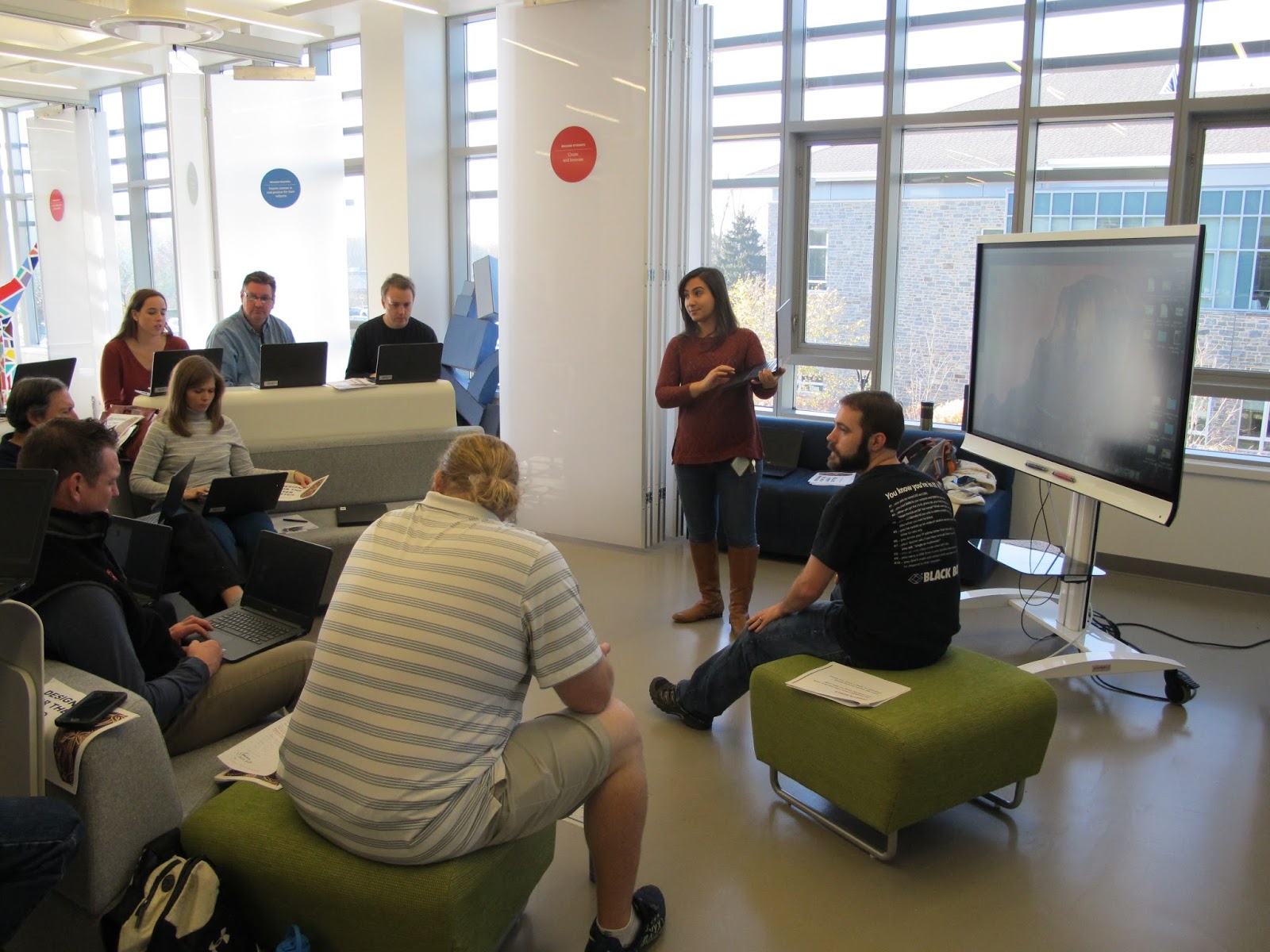
Please enjoy the following pictures of the EXCamp in action.

In order to help the Professional Development Task Force plan for future professional development activities, please take a minute to complete the following feedback form.


Monday, November 7, 2016

Getting All Kinds of HYGGE


Sometimes I surprise myself with how little I know.  For instance, just a few days ago I was introduced to the Danish word “hygge,” pronounced hue-gah~ hoo-guh~ heurgha ~ hU-ge (hU is pronounced with the U sound, closer to hyoo than hoo; ge is short, closer to g than geh). I must have been avoiding this word, fearful that I might choke just trying to say it.  Indeed, fearful of a word that has no translation in English at all…just lame approximations, just weak attempts.

Did you know? Hygge was almost chosen to be the word of the year, but lost out to Brexit.  Where have I been that this contender for word of the year escaped me?

Be warned, there are as many definitions as there are pronunciations.  This is my favorite:

“Hygge (“heu-gah”). The art of building sanctuary and community, of inviting closeness and paying attention to what makes us feel open hearted and alive. To create well-being, connection and warmth. A feeling of belonging to the moment and to each other. Celebrating the everyday.

“Hygge happens when we commit to the pleasure of the present moment in its simplicity. It’s there in the small rituals and gestures we undertake to give everyday life value and meaning, that comfort us, make us feel at home, rooted and generous.

“We all hygge – around a table for a shared meal, beside a fire on a wet night, making coffee together at work, in the bath with a single candle, wrapped in blankets at the end of a day on the beach, sheltering from the rain at a bus stop, lying spoons, baking in a warm kitchen, alone in bed with a hot water bottle and a good book.

“In our overstretched, complex, modern lives, hygge is a resourceful, tangible way to find deeper connection to our families, our communities, our children, our homes and our earth. It’s an uncomplicated, practical method of weaving the stuff of spirit and heart into daily life without sentimentality then taking time to celebrate it on a human scale.

Hygge is a kind of enchantment – a way of stirring the senses, the heart and the imagination, of acknowledging the sacred in the secular – a way of giving something ordinary a special context, spirit and warmth, taking time to make it extraordinary.  About Hygge

The application of this phenomenon to our lives at school is clear. 
·           gathering around the Keurig in the morning,
·           copying handouts for a colleague,
·           rooting for students at a game,
·           providing breakfast for your advisees,
·           comforting a disappointed senior,
·           sharing a good laugh,
·           reorganizing your space to feel a little bit warmer and more welcoming to everyone,
·           shaking your students’ hands as they enter or leave your room.

All these actions performed in the spirit of community, in the spirit of being in the moment and belonging, in some very real way, to our school and to each other… generate hygge right here at GA.

I am a big fan of words. Words are wonderful, and a precise word is  a crown jewel.  Still, I find the ambiguity, the inexactitude of hyyge to offer a warm welcome into its mystery.

Skål!


Maggie